Buy DeFi Yield Insurance to Safeguard Staked Crypto
You've done the hard part. You researched the protocol, checked the APY, bridged your assets, and deposited into a vault that's now earning yield.
Let's walk through exactly what this insurance covers, how to assess the protocols offering it, and where the real limits lie. By the end, you'll have a clear, actionable framework for deciding whether coverage makes sense for your specific staked positions.
Decoding Smart Contract Risk: What Insurance Actually Covers
Before we talk about buying a policy, we need to be crystal clear about what we're insuring against — and what we aren't.
DeFi yield insurance is built around a single concept: smart contract risk. This means coverage triggers when a protocol's deployed code is exploited due to a vulnerability in the contract itself. Think reentrancy attacks, logic errors, flash loan manipulations, or oracle exploits. If an attacker drains funds because the code allowed it, that's the domain of smart contract insurance.
What it does not cover is equally important, and this is where many stakers get tripped up:
- Phishing attacks — if you sign a malicious transaction or approve a drainer contract, that's on you
- Private key compromise — lost seed phrase, compromised hot wallet, social engineering
- User error — sending funds to the wrong address, interacting with the wrong contract
- Market risk — impermanent loss, token depegging, or general price crashes
- Protocol governance decisions — if a team decides to migrate or shut down voluntarily
The distinction matters because DeFi insurance providers like Nexus Mutual and InsurAce specifically tie coverage to a smart contract address. When you purchase a policy, you're selecting which protocol's contract you want covered — not a blanket "protect my portfolio" shield. This is a precision tool, not a safety net for everything.
Insurance covers code vulnerabilities, not your mistakes. If the contract itself is exploited, you're protected — but a phishing link bypasses every policy on the market.
Evaluating Protocol Security Beyond Audit Reports
Here's a trap we see constantly: stakers check whether a protocol has been audited, see the CertiK badge, and assume they're safe. An audit is a snapshot of the code at a specific moment — it is not a seal of invincibility.
Protocols upgrade their contracts. New features introduce new attack surfaces. A vault that was secure six months ago might have a freshly deployed router that's never been reviewed. Even protocols with "High" security ratings on DefiLlama can be exploited if the team pushes a contract update without re-auditing.
So how do we actually assess whether insurance is worth the premium for a given protocol? Let's look at a practical checklist:
1. Audit recency — When was the last audit performed? If the protocol has upgraded since, that audit is stale. Look for ongoing audit relationships, not one-time reports
2. Bug bounty programs — Active bounties on Immunefi or similar platforms signal a team that takes continuous security seriously, not just a checkbox exercise
3. Upgrade patterns — Does the protocol use proxy contracts (upgradeable)? If so, the attack surface changes with every implementation update, and your original audit assessment may no longer hold
4. TVL-to-audit ratio — A protocol holding $500M in TVL with a single audit from two years ago is a different risk profile than one with $50M and three concurrent audits
5. Exploit history — Has the protocol been exploited before? If so, what was the post-mortem quality? Teams that publish transparent post-mortems and patch quickly deserve more trust than those that go silent
| Risk Indicator | Low Risk Signal | High Risk Signal |
|---|---|---|
| Audit recency | Audited within last 6 months | Last audit 2+ years ago, with code changes since |
| Contract upgradeability | Immutable contracts or timelocked upgrades | Admin key can push upgrades instantly |
| Bug bounty | Active, well-funded Immunefi program | No bounty or token-only rewards |
| Exploit history | Clean record or transparent post-mortem | Past exploits with no public analysis |
| TVL management | Diversified across multiple strategies | Concentrated in a single volatile strategy |
This assessment tells you how badly you need insurance — and helps you evaluate whether a protocol's risk profile justifies the premium cost.
Navigating Coverage Selection: Premiums, Durations, and Asset Denominations
Once you've decided to buy coverage, the next step is understanding what you're actually purchasing. Let's break down the key parameters.
Coverage duration typically ranges from 30 days to one year. If you're staking in a pool with a known unlock date, match your policy to that window. There's no reason to pay for a year of coverage if your position closes in 90 days.
Cover amount is denominated either in the underlying asset (ETH, for example) or in a stablecoin equivalent. This is the maximum payout you'd receive if a valid claim is approved. If you have 5 ETH staked, you'd want coverage denominated in ETH at that amount — not a stablecoin figure that might not match the asset's value at the time of exploit.
Premium costs generally fall between 1% and 5% of the coverage amount per year, and this range is driven entirely by the risk assessment of the specific protocol you're covering. A battle-tested lending protocol with three audits might land at 1.2%, while a newer yield aggregator with unaudited vaults could push toward 4.5% or higher.
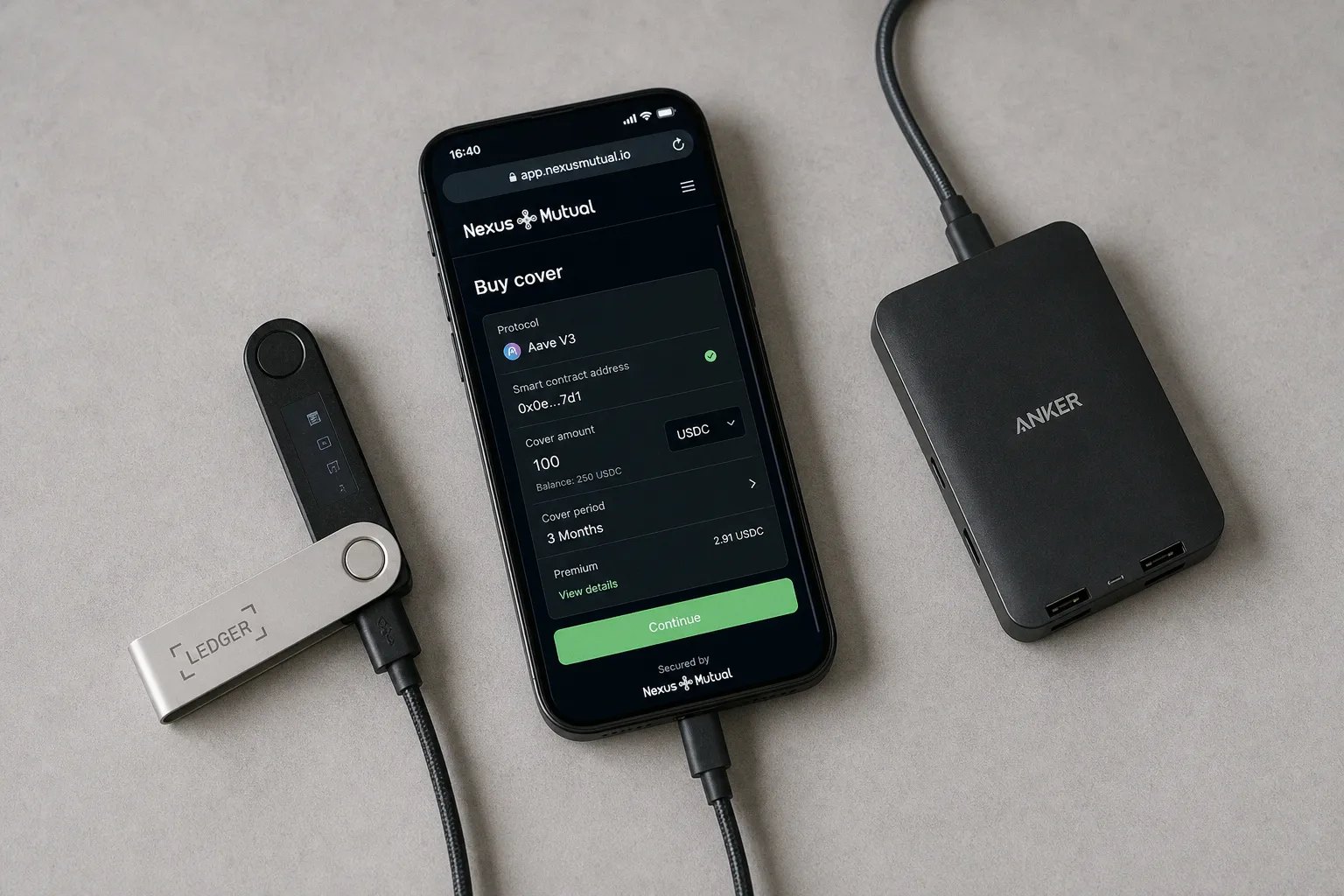
Here's how the purchase flow works on a protocol like Nexus Mutual:
1. Connect your wallet — MetaMask, Rabby, or any EVM-compatible wallet to the insurance protocol's dApp
2. Navigate to "Get Cover" — You'll find a list of available protocols and their associated smart contract addresses
3. Select your protocol — Choose the specific platform where your assets are staked
4. Set your cover amount and duration — Input how much you want covered and for how long
5. Review the premium — The platform calculates cost in real time based on current risk pricing
6. Pay the premium — Confirm the transaction; premiums are paid upfront in ETH, DAI, or the protocol's native token (NXM for Nexus Mutual)
7. Receive your cover NFT — Your policy is tokenized as an NFT representing your coverage terms
Your coverage is only as specific as the contract address you select — choose carefully, because a wrong address means a policy that protects nothing you actually hold.
One critical detail: coverage doesn't auto-renew. When the policy expires, you need to manually purchase a new one. Set a reminder — a gap in coverage during a high-activity period for the protocol is exactly when things tend to go wrong.
The Mechanics of Claim Assessment and Governance Voting
This is the section most guides skip, and it's arguably the most important. Buying insurance is meaningless if you don't understand how claims are actually paid out.
When an exploit occurs, here's the typical sequence:
1. Incident is reported — Either by the affected protocol, community members, or security researchers. The insurance protocol's team reviews the on-chain evidence
2. Claim is submitted — Policyholders file a claim through the insurance protocol's interface, providing transaction hashes and evidence of the exploit
3. Assessment period begins — This usually takes 7 to 14 days. During this window, a decentralized Claims Assessment committee (or, in some cases, all staking members of the insurance protocol) reviews the evidence
4. Governance vote — Assessors vote on whether the claim is valid. In Nexus Mutual's model, staked NXM holders participate in claims decisions, creating a decentralized jury system
5. Payout or denial — If the vote passes, funds are released to the claimant. If denied, you have limited recourse — this is why understanding the governance structure before you buy matters enormously
The governance layer introduces a human element that pure-code insurance solutions would avoid. On one hand, this means nuanced cases get fair hearings. On the other hand, it means your payout depends on a group of token holders interpreting whether your situation qualifies. Edge cases — partial exploits, economic attacks that don't technically break code logic, or exploits that get partially recovered — become judgment calls.
The industry is trending toward more automated, on-chain claim assessment, particularly in the 2024–2025 period, but we're not fully there yet. For now, governance voting remains the dominant mechanism, and you should factor that into your risk tolerance.
Minimum coverage amounts also vary, but they often start around 0.1 ETH or its equivalent. If you're staking a small position, make sure the premium-to-coverage ratio still makes economic sense — paying a 3% premium on a 0.5 ETH position might not be worthwhile if you're comfortable self-insuring that amount.
Strategic Limitations: What DeFi Insurance Policies Exclude
Let's be direct about what insurance won't do for you, because misunderstanding coverage boundaries is how stakers end up with denied claims and a bad taste for the entire concept.
Impermanent loss is almost never covered. This is the silent killer for liquidity providers, and it's a market risk, not a smart contract risk. No major insurance protocol we've examined covers IL across all liquidity pools. Some niche products exist, but they're experimental and limited in scope.
Rug pulls are a gray area. If the team deliberately drains funds — a true exit scam — it depends on how they do it. If they exploit a backdoor coded into the smart contract, some policies might cover it. If they simply control the admin keys and move funds through a legitimate administrative function, most claims will be denied. The distinction is technical but critical.
Cross-chain risks are fragmented. If you bridge assets to a Layer 2 and the bridge gets exploited, your DeFi insurance on the destination chain protocol doesn't cover the bridge failure. You'd need separate bridge insurance, which is a thinner and less mature market.
Protocol insolvency isn't covered either. If a lending protocol becomes undercollateralized due to cascading liquidations — the kind of systemic event we saw in several 2022 collapses — that's an economic failure, not a code exploit. Your policy stays silent.
Here's our recommended approach to layering insurance into a broader risk strategy:
1. Self-insure small positions — If the staked amount is below your personal risk threshold, the premium cost may exceed the benefit. Know your number
2. Insure concentrated exposure — If 40% of your yield portfolio sits in a single protocol, coverage becomes far more valuable. Diversification is cheaper than insurance, but insurance fills the gap where diversification can't
3. Stack with hardware wallet security — Insurance doesn't cover key compromise, so a hardware wallet is your first line of defense. Insurance is layer two
4. Review coverage quarterly — Protocols change. Audits expire. New vaults launch. Your insurance should reflect your current exposure, not your exposure from three months ago
5. Read the claims history — Before buying from any insurance protocol, check their historical claims data. A provider that routinely denies claims on technicalities is not providing real protection
For broader context on building resilient personal systems beyond just DeFi — whether that's managing your time, structuring your routines, or building habits that compound — practical life strategy resources like Cosmo2Tree remind us that risk management isn't just a crypto concept; it's a life framework.
Putting It All Together
DeFi yield insurance isn't a luxury — it's a calculated decision that belongs in every staker's workflow. The process is straightforward: connect your wallet, select the protocol whose smart contract you want covered, choose your amount and duration, pay the premium, and hold your coverage NFT. But the value lies in everything surrounding that process — assessing whether the protocol actually warrants coverage, understanding what's excluded, and knowing how claims really get decided.
Start with the protocols where you hold the largest positions. Run the security checklist. If the risk profile warrants it, get covered. If it doesn't, at least you've made that call with clear eyes rather than hopeful ignorance.
The DeFi space rewards the prepared. Insurance is how we prepare for the part we can't control — the code we didn't write.