Free crypto mining app for android: step-by-step setup
A free crypto mining app for Android cannot legally perform conventional proof-of-work mining on the phone through Google Play. Google’s policy prohibits apps that mine cryptocurrency on a user’s device.
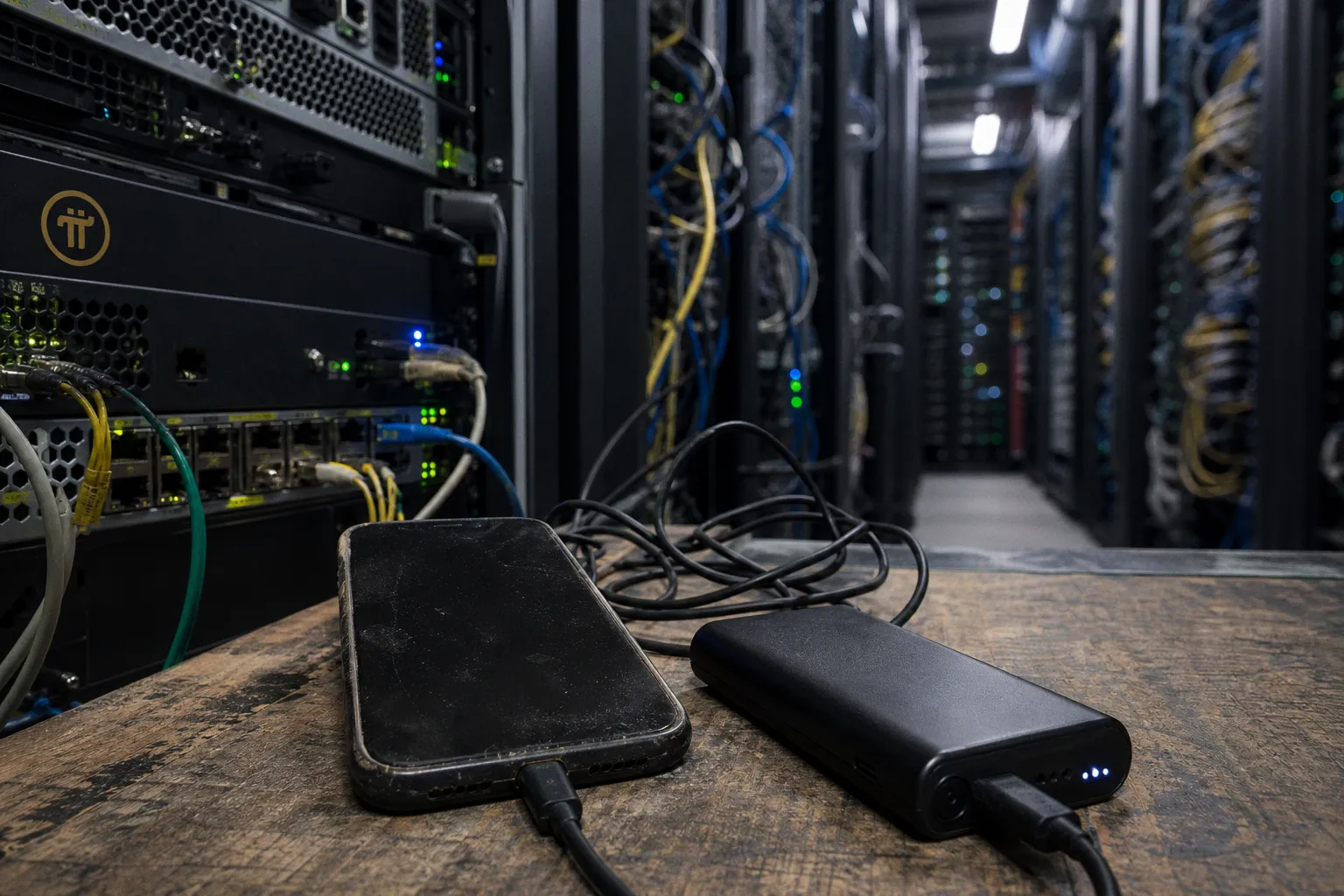
It permits apps that remotely manage mining operations, but that is a different architecture entirely.
This eliminates the premise behind most searches for “crypto mining on smartphone.” A phone has no viable SHA-256 or GPU mining profile. Its thermal envelope is narrow, its battery is finite, and its hardware overhead exceeds any plausible output. If an Android app claims it mines Bitcoin or another proof-of-work asset locally without dedicated hardware, the claim conflicts with both platform policy and basic economics.
What remains are three distinct models:
1. Daily check-in and network-participation reward apps.
2. Mobile DePIN apps that contribute data or compute-adjacent services.
3. Remote mining dashboards, often marketed as Android cloud mining rewards.
They should not be evaluated under the same assumptions. A daily check-in is not mining. A data-contribution app is not a node. A cloud-mining dashboard is not evidence that any hash rate exists.
A balance displayed in an Android app is not an on-chain asset until it is transferable, withdrawable, and independently verifiable.
The Technical Reality of Mobile Mining on Android
A standard Android phone is not mining hardware. It lacks the ASIC efficiency required for Bitcoin mining and lacks the sustained GPU capacity used by proof-of-work networks that remain GPU-accessible. Even where a technically possible miner exists outside Google Play, it creates heat, battery wear, throttling, and negligible output.
The hardware mismatch is straightforward.
| Parameter | Android phone | Dedicated mining or node hardware |
|---|---|---|
| Primary design target | Mobile applications, communications, camera, battery operation | Hashing, packet forwarding, storage, validation, or persistent compute |
| Thermal headroom | Limited; performance throttles under sustained load | Designed for continuous workloads with active cooling or low-power architecture |
| Uptime requirements | Interrupted by charging cycles, OS power management, mobility, app suspension | Usually continuous power and stable network connectivity |
| Network role | Client device | Validator, gateway, storage host, packet forwarder, or server |
| Economic output | Usually app-issued points or token allocations | Depends on measurable service: traffic, coverage, storage, compute, or staking |
| Main attack vector | Malicious APK, credential theft, fake withdrawal flow, excessive permissions | Key compromise, uptime failure, slashing conditions, misconfigured software, hardware failure |
The phrase “free crypto mining app for Android” is therefore usually a category error. The app may be free to install. It may issue a balance. But it is not necessarily mining, and the balance may have no immediate transfer path.
Google Play permits remote management apps. An app can show the status of an external ASIC, VPS node, validator, or cloud account. It cannot use the handset itself as an approved local cryptomining engine. That distinction matters because scam operators routinely blur it.
A legitimate remote-management app should disclose the underlying infrastructure:
- The mining hardware, server, or node operator.
- The network being mined or serviced.
- The wallet address or payout mechanism.
- The fee model and custody model.
- The minimum withdrawal threshold.
- The chain on which withdrawals settle.
- The operator’s role in holding private keys or controlling rewards.
If those items do not exist, there is no infrastructure to audit. The app is only an interface with an internal counter.
Reward Apps, DePIN Apps, and Real Nodes Are Different Systems
The operational test is simple: identify the service the user provides to the network.
Pi Network is a common example of a mobile reward mechanism. Its Android application does not use the phone’s processor, network, or other resources for proof-of-work mining. The documented workflow is a check-in cycle: the user starts a session every 24 hours by pressing the lightning button. The session can continue after the app is closed.
That is not a defect. It is simply not hardware mining. The app’s reward model is tied to participation, network growth, trust-graph functions, and its ecosystem rules. Users should not describe it as passive hashrate generated by a phone.
Pi also separates a displayed mobile balance from transferable value. Its documentation states that unverified and unmigrated balances are not transferable. Mainnet migration requires KYC. This is the critical control point. A token allocation that cannot pass identity verification, migrate, and move to a self-controlled wallet is not liquid yield.
After three mining sessions, Pi makes the Contributor role and Security Circle option available. The Security Circle can affect the mining rate and is intended to support the network trust graph. That mechanism has a security function, but it also creates a social dependency: the reward rate is not merely a function of a device running in the background.
NATIX Drive& represents a different architecture. It is closer to a mobile DePIN contribution system. The user contributes road-event data while driving, and the application uses on-device edge computing. The device is performing a limited data-processing role rather than proof-of-work hashing.
NATIX estimates roughly 1 GB of monthly mobile-data use for heavy users. That is materially lower than hardware dashcam projects that transmit images and can consume roughly 50–200 GB monthly for heavy use. The lower data burden is relevant, but it does not remove the cost model:
- Data contributes a real recurring cost if the user has a capped mobile plan.
- GPS, camera, and background execution increase battery consumption.
- Rewards depend on useful data, geography, driving patterns, protocol rules, and token economics.
- A contributor is not operating a decentralized node in the infrastructure sense.
Helium IoT is an actual infrastructure deployment. It requires a LoRaWAN gateway and packet-forwarder software. An Android phone may manage a wallet or support onboarding, but it cannot replace the gateway.
A Helium hotspot also has explicit onboarding costs. Adding a hotspot costs 50,000 Data Credits, equivalent to $0.50. Asserting its location costs another 50,000 Data Credits. The documented baseline is therefore 100,000 Data Credits, or $1 total, plus Solana transaction fees. The protocol documentation references approximately 0.01 SOL for those transactions.
The distinction continues after setup. Helium hotspots earn for carrying device data. A Data-Only Hotspot can earn Network Data Transfer rewards but cannot earn Proof-of-Coverage rewards. In other words, the network compensates measurable infrastructure service, not app installation.
DePIN yield starts where measurable network service starts: coverage, traffic, storage, compute, or validated data.
Step-by-Step: Classify the Android App Before You Install It
Treat every mobile earning application as an untrusted system until its operational model is clear. This is not an emotional warning. It is a threat-model requirement.
1. Identify the claimed source of rewards
Read the project documentation before creating an account. The explanation should answer one direct question: what resource is being monetized?
Valid categories include:
- Daily participation or a network-growth allocation.
- Location or road-event data contribution.
- Bandwidth sharing through separate hardware.
- Storage supplied by a server or dedicated device.
- Compute delivered by a VPS or node machine.
- Mining operated remotely by identifiable hardware.
Invalid or incomplete explanations usually rely on phrases such as “AI mining,” “automatic cloud income,” “mobile hash acceleration,” or “activate mining.” None of those terms identifies an economic service.
If the app says it mines in the cloud, request the infrastructure evidence mentally before granting it trust. Which operator owns the rigs? What chain receives the block rewards? What is the payout address? What pool is used? What is the user’s contractual or on-chain claim on generated revenue? A dashboard cannot answer these questions by displaying a rising number.
2. Verify the platform and publisher
Install only through the official Google Play listing or a link from the project’s documented website. Do not sideload APK files sent through Telegram channels, Discord direct messages, referral groups, or search ads.
Sideloading changes the threat model. It bypasses ordinary store controls and can introduce credential theft, clipboard replacement, accessibility abuse, or wallet-draining malware. An APK requesting accessibility access, device administrator privileges, SMS access, or persistent overlay permission has a large attack surface for a supposed rewards app.
Check the publisher identity. A mismatch between the website’s stated developer and the Play Store publisher is a stop condition. So is a recently created publisher account with cloned branding, copied screenshots, or an unrelated privacy policy.
Do not treat a high app-store rating as a security control. Ratings, downloads, referral campaigns, and screenshots of earnings do not prove that rewards are backed, transferable, or withdrawable.
3. Use a segregated wallet architecture
Do not connect a primary wallet containing meaningful assets to a new mobile rewards application.
Use a wallet with no material balance for initial interaction. Keep seed phrases offline. Never enter a recovery phrase into an Android app to “verify” ownership or restore mining rewards. A legitimate protocol may request a wallet connection signature. It does not require the seed phrase.
For an app with a custodial balance, establish these facts before investing time:
1. Is there a wallet address on a public chain?
2. Can the user export or withdraw the balance?
3. Is KYC required before migration or withdrawal?
4. Is there a minimum threshold?
5. Does the protocol charge a fee to unlock funds?
6. Can the balance be independently verified outside the application?
A withdrawal fee paid in crypto to release an already-earned balance is a high-risk pattern. The same applies to “tax,” “activation,” “upgrade,” or “node rental” fees demanded after the app reports a large balance.
4. Measure actual device overhead for seven days
A mobile contribution app has operating costs even if it is free. Record them rather than estimating.
Track:
- Battery consumption attributable to the app.
- Mobile-data usage.
- Background location and camera access.
- CPU activity and device temperature.
- Frequency of crashes or forced background termination.
- Reward accrual and any change after permission limits.
- Whether the reward can be transferred or remains internal.
This test is especially relevant for passive income phone apps that collect data. If the application requires continuous GPS access, camera access, and background processing, it is consuming resources. Its output must exceed those costs to be economically rational.
Do not confuse a low visible battery drain with free operation. Android’s background restrictions may simply be preventing the app from doing the work it claims to perform. The result is poor uptime, reduced data contribution, and lower rewards.
5. Verify transferability before scaling effort
A project can be technically legitimate while still producing no practical yield for a specific user. Reward tokens may be locked, subject to KYC, restricted by jurisdiction, or below the withdrawal threshold.
Pi’s model demonstrates why this step is non-optional. Unverified and unmigrated balances are not transferable. The correct sequence is not “accumulate first, investigate later.” It is:
1. Confirm the identity-verification path.
2. Confirm Mainnet migration requirements.
3. Confirm that the relevant balance category can migrate.
4. Confirm wallet access and transfer mechanics.
5. Only then assess the value of continued participation.
The same method applies to Android cloud mining rewards. If an app cannot produce a verifiable payout history or a functioning withdrawal path, its displayed balance has no reliable economic value.
Security Failures in Mobile Mining Apps
The Android mining category has a documented scam history. In July 2021, Lookout reported more than 170 Android apps associated with paid cloud-mining fraud, estimating more than 93,000 victims. Its researchers found that no cloud mining took place in the investigated cases. Twenty-five of the apps had been available on Google Play before removal.
That does not prove every current app is fraudulent. It does establish a repeatable attack pattern: an operator can display fabricated earnings, use referral incentives to acquire users, and delay the extraction event until a deposit or withdrawal attempt.
The primary attack vectors are predictable.
| Attack vector | Typical mechanism | Audit response |
|---|---|---|
| Fake cloud mining | App displays simulated hash rate and fabricated balance | Require verifiable operator, mining infrastructure, payout logic, and withdrawal evidence |
| Advance-fee extraction | “Tax,” activation, upgrade, or release fee required before withdrawal | Do not pay crypto to unlock an in-app balance |
| Wallet compromise | Seed phrase request, malicious wallet connection, fake support channel | Use segregated wallet; never disclose recovery phrase |
| Referral-driven opacity | Bonuses hide lack of on-chain utility or withdrawal route | Evaluate transferability independently of referral rewards |
| Permission abuse | Excessive access to location, SMS, accessibility, overlays, contacts | Deny unnecessary permissions; uninstall if the app cannot operate with minimal access |
| KYC bait-and-switch | Identity documents requested without a defined migration process | Read the published KYC and withdrawal conditions before submitting documents |
The Federal Trade Commission identifies guaranteed profits, quick and easy returns, and demands for advance crypto payments as scam indicators. Those signals map directly onto the fake-mining-app model.
A protocol that makes no yield guarantee is not automatically legitimate. But a protocol that guarantees fixed daily income while hiding the capital source has already failed basic economic review.
The Economics: Time, Data, Hardware, and Liquidity
The correct calculation is not “How many tokens does the app show today?” It is “What service is produced, what does it cost, and can the reward leave the system?”
For a mobile app, gross reward is only one variable. Net yield is closer to:
Transferable reward value − data cost − battery degradation − time cost − transaction fees − opportunity cost
The formula is intentionally severe. Most mobile rewards fail somewhere in it.
A daily check-in app may have near-zero hardware overhead. Its direct cost is mostly time and the uncertainty of future transferability. That can make participation acceptable as an experimental allocation, but it does not make it passive income in the conventional sense.
A DePIN data app has a clearer service model. It may collect useful location or road-event data, but the user must price battery use, data consumption, privacy exposure, and the probability that rewards are liquid. NATIX’s approximate 1 GB monthly figure for heavy Drive& use is manageable on an unlimited plan and material on a limited one. The number is not universal, but the accounting principle is.
A real node has the clearest infrastructure function and the highest setup burden. Helium requires hardware, location assertion, onboarding credits, a wallet, and network conditions that support useful service. A VPS node setup guide for another protocol will have a different stack: server cost, RAM, storage, bandwidth, firewall policy, key custody, version maintenance, and uptime requirements.
This is where many users make the wrong comparison. They compare a phone app against a node only by entry cost. The actual comparison is between different revenue mechanisms.
| Model | Upfront cost | Ongoing overhead | Reward dependency | Transferability risk |
|---|---|---|---|---|
| Mobile check-in app | Usually zero | Daily manual action | Protocol participation rules, verification, ecosystem status | Often high until migration is complete |
| Mobile DePIN contribution | Usually zero | Data, battery, location permissions, activity pattern | Useful contributed data and protocol reward rules | Depends on token liquidity and withdrawal support |
| Remote cloud-mining app | Often marketed as zero | Time, possible deposit pressure | Operator honesty and undisclosed infrastructure | Very high if payout cannot be independently verified |
| Physical hotspot or node | Hardware and onboarding costs | Power, internet, maintenance, uptime | Traffic, coverage, location, protocol parameters | Usually lower if rewards settle on-chain, but economics remain variable |
No universal daily income figure is credible across these models. Rewards can change with token price, emissions, verification status, location, user behavior, traffic demand, and protocol governance. A mobile app that paid a small amount last month has not established a durable yield rate.
What a Legitimate Mobile Setup Actually Looks Like
For Android users, the defensible setup is narrow.
Install a documented app through Google Play. Confirm what resource or action generates rewards. Restrict permissions to those necessary for the stated function. Use a segregated wallet. Complete only the verification steps that have a documented reason. Test whether rewards can migrate or withdraw. Record real operating overhead. Stop if the protocol demands an advance crypto payment to release earnings.
For Pi-style participation, that means a 24-hour check-in cycle and a clear understanding that the mechanism is not local mining. It also means treating KYC and Mainnet migration as operational dependencies, not fine print.
For a NATIX-style DePIN app, it means permitting data collection only if the user accepts the location, battery, and mobile-data profile. The economic output depends on usable contribution, not on leaving an app open.
For Helium or any similar physical infrastructure project, it means abandoning the “free phone-only setup” premise. Buy or operate the required hardware only after modeling location quality, expected traffic, onboarding fees, internet reliability, and maintenance. An Android device can support management. It cannot substitute for a LoRaWAN gateway.
The binary verdict is straightforward: a free Android app can be a legitimate participation or data-contribution tool, but it is not a profitable on-device crypto miner. If the app cannot identify the service provided, prove transferability, and survive a basic permission and withdrawal audit, do not install it.